Advertisement
Complete Guide to Getting a Software Job in India Without a Degree
In India, lakhs of people believe a computer science degree is the only path to a software job. That belief is wrong. Here is the complete guide to getting hired as a software developer without a CS degree.
Does a Degree Matter in 2026
For product companies (Google, Microsoft, Flipkart, Swiggy), they look at skills and problem-solving ability — degree is secondary. For service companies (TCS, Infosys, Wipro, Cognizant), they prefer degrees but hire based on aptitude tests too. For startups, skills completely outweigh degrees. The truth: a strong GitHub portfolio and real projects will get you more interviews than a degree from a tier-3 college.
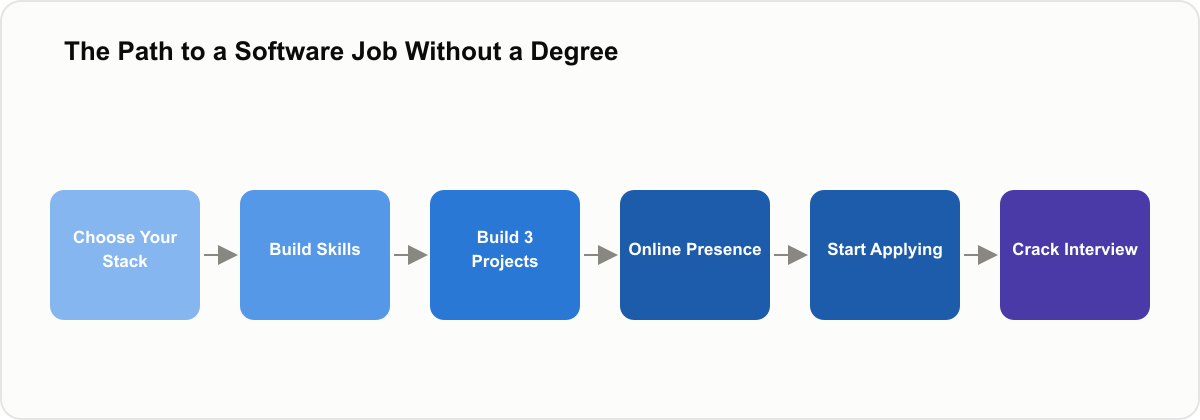
Step 1 — Choose Your Stack
Do not try to learn everything — pick one and go deep.
Option A: Frontend Development
- HTML, CSS, JavaScript, React
- Time to job-ready: 4-6 months
- Salary range: ₹4-12 LPA
Option B: Backend Development
- Python/Java + SQL + APIs
- Time to job-ready: 5-7 months
- Salary range: ₹5-15 LPA
Option C: Full Stack Development
- Frontend + Backend combined
- Time to job-ready: 8-12 months
- Salary range: ₹6-18 LPA
Option D: Data Science
- Python + pandas + ML basics
- Time to job-ready: 6-9 months
- Salary range: ₹5-14 LPA
Step 2 — Build Your Skills
Free resources that are good enough to get hired:
- For web development: The Odin Project + freeCodeCamp
- For Python/backend: CS50P + official Python docs
- For data science: Kaggle Learn (completely free)
- For full stack: Full Stack Open by University of Helsinki (free)
Spend 2-3 hours daily. Consistency beats intensity.
Step 3 — Build 3 Projects
This is the most important step — recruiters want to see that you can build real things. Your projects should:
- Solve a real problem
- Be on GitHub with clear README
- Have a live demo link (use Vercel or Netlify — both free)
Project ideas for beginners: an expense tracker with charts, a weather app with real API data, a job application tracker, a recipe finder app, or a URL shortener.
Step 4 — Build Your Online Presence
LinkedIn profile:
- Professional photo
- Strong headline: "Frontend Developer | React | JavaScript"
- List all projects with GitHub links
- Get 3-5 recommendations from connections
GitHub profile:
- Pin your 3 best projects
- Write clear README files with screenshots
- Contribute to open source (even small fixes count)
Step 5 — Start Applying
Where to apply:
- LinkedIn Jobs — filter by "Entry Level"
- Internshala — great for first internships
- Naukri.com — good for service companies
- Angellist/Wellfound — best for startups
- Company career pages — apply directly
Apply to 20-30 jobs per week. Expect a 5-10% callback rate.
Step 6 — Crack the Interview
Technical interviews test data structures and algorithms (LeetCode Easy/Medium), your project knowledge — be ready to explain every line — and basic system design for senior roles. Non-technical interviews test communication skills, problem-solving approach, and cultural fit. Prepare by solving 50 LeetCode Easy problems before interviews.
Salary Expectations
Fresher (0-1 year experience):
- Startup: ₹3-6 LPA
- Mid-size company: ₹4-8 LPA
- MNC: ₹5-10 LPA
With 2 years experience:
- Startup: ₹8-15 LPA
- MNC: ₹10-20 LPA
Real Timeline
- Month 1-3: Learn the basics of your chosen stack
- Month 4-6: Build 3 projects and put them on GitHub
- Month 7: Start applying and prepare for interviews
- Month 8: Get your first offer
Eight months — that is the honest timeline for a dedicated person.
Final Advice
Stop waiting for the perfect course or the perfect time. Start learning today. Build something bad, then build something better. Every senior developer you admire started exactly where you are now.
Frequently Asked Questions
Advertisement
Was this article helpful?
Advertisement
Comments
No comments yet. Be the first to share your thoughts!
Related Posts

Top 5 Free Online Courses That Can Get You a Job in 2026
The platforms employers in India actually recognize, and how to pick the right one for your goal
Five free platforms with certificates employers actually respect — what each one takes to finish, what it's worth, and how to pick the right one for your specific goal.
How to Prepare for a Technical Interview: A Step-by-Step Guide for Freshers
A four-week plan for what to practice, in what order, and how to actually answer under pressure
A structured four-week plan for technical interview prep, plus the non-technical habits — going silent while thinking, not asking clarifying questions — that quietly cost freshers offers.
How to Write a Resume That Actually Gets Shortlisted
Before-and-after examples of turning weak bullet points into ones recruiters stop on
Recruiters scan a resume for about six seconds. Before-and-after examples of weak vs. strong bullet points, the structure that actually gets read, and the mistakes that get resumes rejected instantly.