Advertisement
How to Learn Python in 30 Days — Complete Beginner Roadmap
Python is the most beginner-friendly programming language in the world. It reads like English, runs on any computer, and is used everywhere — from Netflix to NASA. This 30-day roadmap will take you from zero to writing real Python programs.
Why Python in 2026
Python is the number one language for:
- Data science and machine learning
- Web development (Django, FastAPI)
- Automation and scripting
- AI and ChatGPT integrations
Average Python developer salary in India: ₹5 – 18 LPA.
What You Need to Start
- A laptop (any laptop works)
- Internet connection
- 1-2 hours per day
- Python installed (free at python.org)
Week 1 — Foundations (Days 1-7)
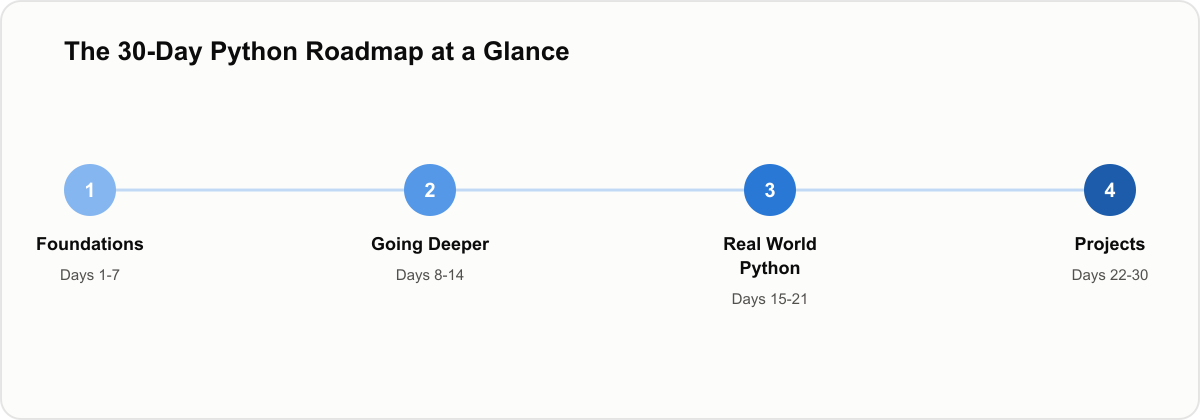
- Day 1: Install Python and VS Code. Write your first program.
- Day 2: Variables, data types, print statements
- Day 3: If/else conditions and comparison operators
- Day 4: Loops — for loop and while loop
- Day 5: Functions — defining and calling
- Day 6: Lists and list operations
- Day 7: Dictionaries and sets
Practice: Write a simple calculator by end of Week 1.
Week 2 — Going Deeper (Days 8-14)
- Day 8: String methods and formatting
- Day 9: File handling — read and write files
- Day 10: Error handling with try/except
- Day 11: Modules and importing libraries
- Day 12: Classes and object-oriented programming basics
- Day 13: Working with dates and times
- Day 14: List comprehensions and lambda functions
Practice: Build a to-do list app that saves to a file.
Week 3 — Real World Python (Days 15-21)
- Day 15: pip and installing packages
- Day 16: Requests library — fetch data from the web
- Day 17: JSON — reading and writing JSON data
- Day 18: pandas basics — working with data tables
- Day 19: matplotlib — making charts and graphs
- Day 20: BeautifulSoup — web scraping basics
- Day 21: Regular expressions
Practice: Scrape a website and save data to a CSV file.
Week 4 — Projects (Days 22-30)
- Days 22-24: Build a weather app using a free API
- Days 25-27: Build a personal expense tracker
- Days 28-29: Build a simple web scraper for job listings
- Day 30: Deploy your project to GitHub
Free Resources to Use
- Python.org official tutorial — completely free
- FreeCodeCamp Python course on YouTube — 4.5 hours, covers everything
- Automate the Boring Stuff with Python — free online at automatetheboringstuff.com
- LeetCode — free practice problems for interviews
Common Mistakes Beginners Make
- Trying to memorize syntax instead of understanding concepts
- Watching tutorials without writing code
- Jumping to advanced topics too early
- Not building projects
After Day 30
Once you finish this roadmap you will have:
- 3 real Python projects on GitHub
- Understanding of core programming concepts
- Foundation to learn data science or web development
The best next step is to pick either Django for web development or pandas/numpy for data science and go deeper in that direction. Start Day 1 today — the only thing between you and Python is the first line of code.
Frequently Asked Questions
Advertisement
Was this article helpful?
Advertisement
Comments
No comments yet. Be the first to share your thoughts!
Related Posts

Google Search Console — How to Add Your Website and Get Free Traffic
Step by step guide to adding your website to Google Search Console and using it to get free organic traffic from Google. Beginner friendly.
10 Best Free Websites to Learn Coding in 2026
Discover the 10 best free websites to learn coding in 2024. From HTML to Python to data science — all completely free with certificates.
SQL Basics: The Queries Every Beginner Should Actually Know
Ten queries that cover most of what you'll use day to day, with runnable examples
Ten SQL queries that cover most day-to-day database work, with runnable examples — SELECT, filtering, joins, aggregation, and the mistakes that trip up beginners.
Git and GitHub for Complete Beginners: A Step-by-Step Guide
From your first commit to your first pull request, without the jargon
A practical walkthrough of Git and GitHub — what problem version control solves, the five commands you'll use daily, and how to set up your first repository.